淘宝官方店 推荐课程 在线工具 联系方式 关于我们 淘宝官方店 推荐课程 在线工具 联系方式 关于我们 |
|
|
微波射频仿真设计 |
|
| 淘宝官方店 推荐课程 在线工具 联系方式 关于我们 |
|
|
微波射频仿真设计 |
|
| 首页 >> Ansoft Designer >> Ansoft Designer在线帮助文档 |
|
Design Verification > SeparationTo CommandsThis section describes the following SeparationTo commands: • SeparationToErrors • SeparationToPolygons
Input: One or two DV layers (containing polygons) Constraint (operator and distance) Measurement region qualifier (optional) Qualifiers (optional) Intersecting Edge qualifier (optional) Raw/Merged qualifier (optional)
Output: DV layer – Type varies with the command. SeparationToErrors outputs a DV layer containing error clusters. SeparationToPolygons outputs a DV layer containing polygons.
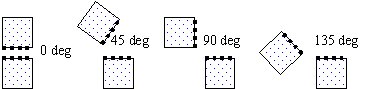
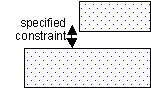
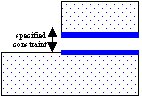
Description: Separation is the distance between the outside facing edges of separate geometry. The single layer version checks the separation between different geometries on the same layer. The two layer version checks the separation between geometry on one layer and geometry on the other layer. This is an edge-to-edge check, not corner-to-corner, or corner-to-edge. For separation checking, edges are considered to face each other only if the angle between the outsides of the edges is less than 180 degrees. Collinear edges are not considered facing. The following figure illustrates the various angles between outside edges:
The arrows in the figures in the following sections indicate the edge pairs that are checked when considering the facing requirement and using default orientation and intersecting qualifiers: Acute Also, Not Obtuse, Parallel Also, Not Perpendicular, and Not Intersecting.
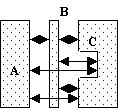
Single Layer Separation For a sufficiently large distance, the separation of edges from polygon A to polygon C is measured. The presence of polygon B between them does not prevent the check.
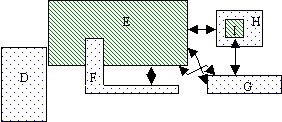
Two Layer Separation Checking is based on the separation of edges, not the separation of the polygons. In some cases shapes that interact are checked.
• The separation between some edges of polygons F and E is checked even though polygon F overlaps polygon E. Notice that the overlap is not checked by this command. • Abutting edges are not checked by default. To trigger checking of the abutting edges of D and E, use the qualifier Intersecting Also or Intersecting Only. • Polygon I is not checked against polygon H because the outsides of the edges don’t face. Polygon I is checked against polygon G. • SeparationToError results are clusters of segments that meet the specified constraint. Each error segment indicates the portion of the geometry edge that meets the constraint. The error clusters are returned in a DV layer.
The heavy lines in the following illustration show the portions of edges that are returned as one error cluster.
SeparationToPolygons results are any polygons that have at least one edge that meets the specified constraints. The polygons are returned in a DV layer. Both polygons in the following illustration are returned.
The heavy lines in the illustration that follows show the segments that are returned as edges. They are not clustered, and they retain information about the directions inside and outside of the polygon and sibling relationship.
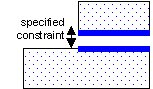
The constraint amount may be given with or without units. If no units are specified, the current default length units are used.
Supported operators:
Qualifiers may be specified to constrain the edges checked. The defaults, if no qualifiers are specified, are Round, Acute Also, Not Obtuse, Parallel Also, Not Perpendicular, Not Intersecting, and Merged.
Example (JScript): var layer1 = DVChecker.ImportLayer("trace"); var sepLayer1 = DVChecker.SeparationToErrors(Array(“<”, “5mm”), layer1, Array( “Round”, “Acute Also”, “Not Obtuse”, “Parallel Also”, “Not Perpendicular”)); DVChecker.SaveLayer(sepLayer1, “separation errors”, “sep < 5 on trace layer”); var layer2 = DVChecker.ImportLayer("ground"); var sepLayer2 = DVChecker.SeparationToErrors(Array(“<”, 5), layer1, layer2, Array( “Round”, “Acute Also”, “Not Obtuse”, “Parallel Also”)); DVChecker.SaveLayer(sepLayer2, “separation errors”, “sep < 5 trace to ground layers”);
HFSS视频教程 ADS视频教程 CST视频教程 Ansoft Designer 中文教程 |
|
Copyright © 2006 - 2013 微波EDA网, All Rights Reserved 业务联系:mweda@163.com |
|

 Ansoft Designer / Ansys Designer 在线帮助文档: